



Beyond the Monolith: Why Retail Logistics Must Break Free from WMS Vendor Lock-In
 ArthurCoFounder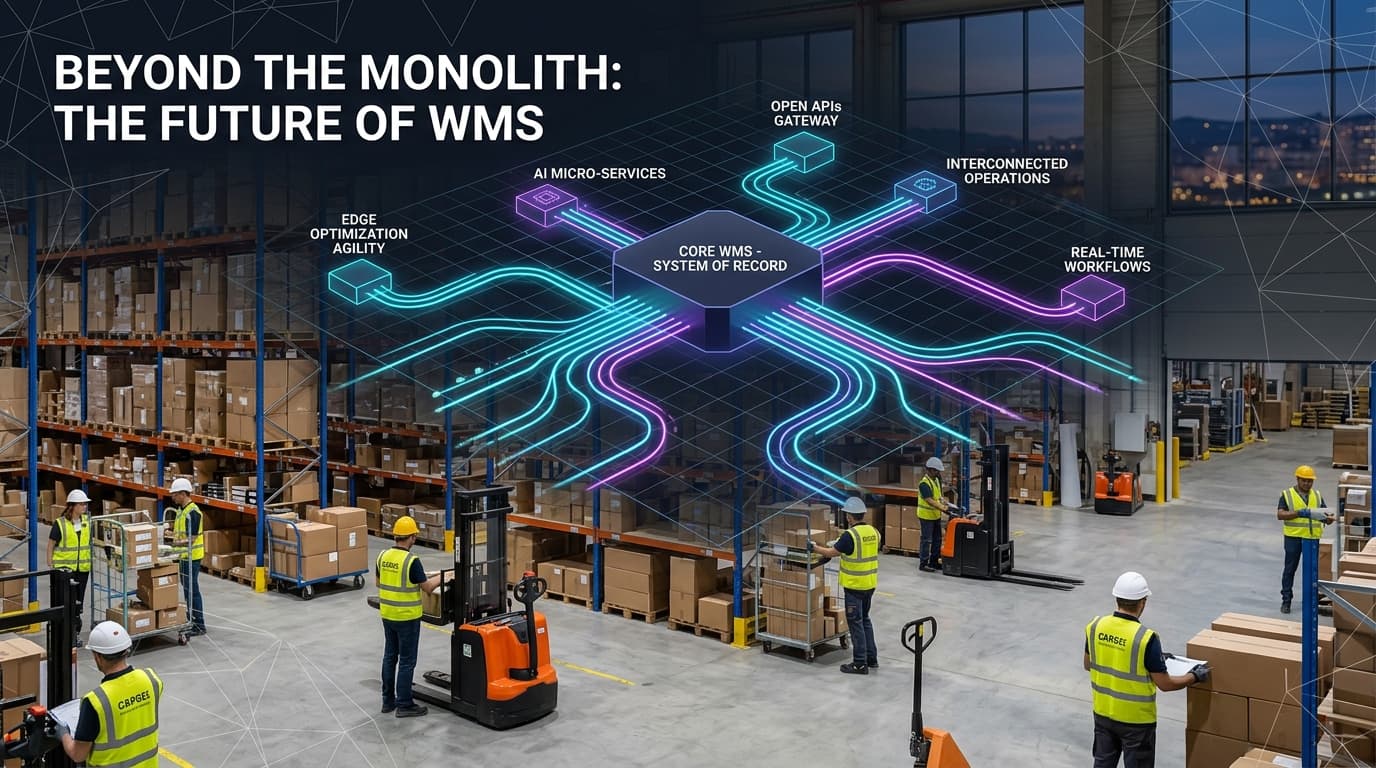
For the past forty years, the retail warehouse has undergone a profound psychological evolution. Every decade, logisticians have adopted a new "source of truth" to manage the chaotic dance of goods.
We started in the era of pure execution, transitioning from clipboard-and-paper to custom, home-made mainframe systems built by internal IT departments desperate to map their inventory. Then came the centralization wave: ERPs promised a single pane of glass for the whole enterprise, only to prove too slow for the fast-paced reality of the warehouse floor. This paved the way for the Best-of-Breed WMS era—robust, web-enabled engines designed to handle the massive volumes of modern retail distribution.
Today, we are told we have entered the AI era. Mainstream industry media and analysts herald the rise of autonomous warehouses and predictive supply chains. Yet, if you walk onto the floor of a typical omnicanal retail fulfillment center, the reality is starkly different.
Behind the marketing buzzwords lies a deeply rigid infrastructure. The modern WMS, once an enabler of efficiency, has become the new monolith—a system that frequently locks the market, stifles open innovation, and resists the very agility retail logistics desperately needs.
1. The Enterprise Bias: Why Mainstream Analysis Ignores Agility
When Tier-1 retail logisticians look for guidance on how to modernize their stack, they naturally turn to legacy technology matrices and mainstream research firms. However, these frameworks suffer from an inherent Enterprise Bias.
By design, legacy evaluation models heavily weigh vendor size, historical market share, and financial "viability." The result? The "Leaders" quadrant is perpetually occupied by the same massive, monolithic software suites. These are solutions designed for stability, not velocity.
For a long time, stability was enough. But in a retail landscape defined by volatile omnicanal shifts, micro-fulfillment, and skyrocketing labor turnover, stability without adaptability is a liability.
When a retail brand needs to dynamically adjust its floor workflows or adapt to a sudden seasonal shift, relying on a legacy WMS vendor often leads to a dead end:
- The Cost Trap: A simple optimization request turns into a six-figure integration invoice.
- The Timeline Trap: Implementation schedules are measured in quarters, not weeks.
- The Closed Ecosystem: Legacy architectures are notoriously hostile to external APIs, effectively locking
out specialized innovation.
This brings the industry to a critical crossroads. If the core WMS cannot adapt fast enough, how do retail
logisticians inject innovation into their operations?
2. The WMS as an Orchestrator: From Monolith to Open Ecosystem
The goal for modern retail logistics is not to tear down the WMS. Replacing a core warehouse management system is the operational equivalent of open-heart surgery—highly risky, incredibly expensive, and rarely disruptive in the right ways. The WMS remains the indispensable "system of record." It owns the inventory data, manages the receiving dock, and handles the final shipping documentation.
The real challenge is transformation: moving the WMS from a closed, rigid monolith to an open orchestrator.
In an ideal retail tech stack, the WMS acts as the central hub, but it pushes specialized execution to the "edge." Rather than trying to hardcode every complex operational logic into the core system, the WMS should focus on its greatest potential strength: aggregation and seamless integration.
The Right Balance: Core Stability vs. Edge Agility
To achieve true operational velocity without collapsing the tech infrastructure, architecture should be split
based on a clear division of labor:
- The Core (WMS): Responsible for data persistence, transaction auditing, cross-channel inventory synchronization, and basic warehouse compliance. It represents stability.
- The Edge (Micro-services / Add-ons): Responsible for real-time operational optimization, algorithmic decision-making, and dynamic workflows. It represents velocity.
When a WMS is built to be interconnected, it doesn't lose value; it multiplies it. An open WMS allows a retail facility to plug in a specialized routing engine today, an automated hardware layer tomorrow, and a new labor management tool the next quarter—all without altering the underlying database structure.
3. The Legacy Counter-Argument: Understanding WMS Risk Mitigation
It is entirely fair to view this from the perspective of conservative WMS product teams and IT directors. Their resistance to third-party integrations isn't always born out of pure protectionism; it is often rooted in a legitimate need for systemic risk mitigation.
When a core WMS vendor opens its ecosystem to external solutions, it introduces variables they cannot control. They must ask tough, operational questions:
- The Maintenance Liability: If a third-party system updates its protocol, who fixes the broken pipeline? WMS providers must protect their core software from being dragged down by poorly maintained external dependencies.
- Operational Edge Cases: Warehouses are chaotic environments. If an exception occurs on the floor—a damaged barcode, a blocked aisle, a sudden network drop—the system must fail-safe. Monolithic systems ensure that when something breaks, the entire data loop stays contained. Introducing external systems requires robust error-handling protocols so that an edge-case glitch doesn't corrupt the master inventory data.
- System Longevity: A Tier-1 WMS expects to live in an enterprise stack for 10 to 15 years. They need to ensure that the operational logic governing the warehouse floor isn't dependent on volatile tech solutions that might not exist or be supported five years down the road.
4. The Pragmatic Path Forward: The Middleware Layer as Find & Order's Core DNA
To bridge the gap between enterprise security and modern operational needs, the industry must move toward robust, bi-directional API standards and secure middleware layers. Risk mitigation shouldn't mean lock-in. Instead of blocking external innovation, the modern WMS must develop secure sandboxes and standardized webhooks.
This exact tension is precisely why we built Find & Order. We do not believe in replacing your WMS. We believe in liberating it.
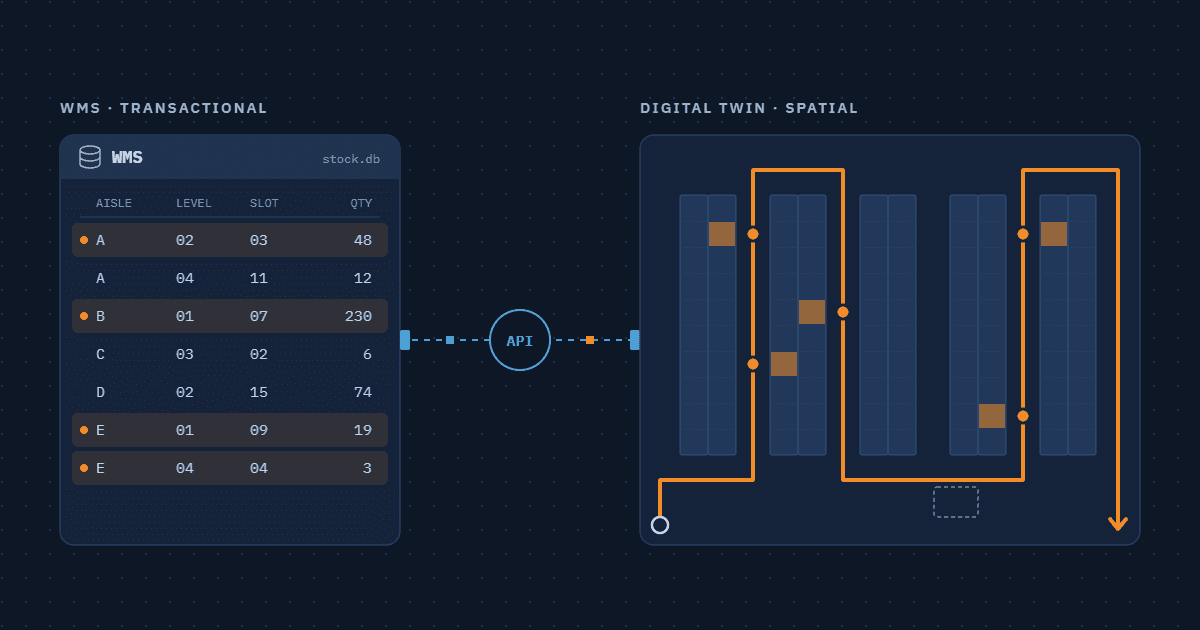
Our approach is rooted entirely in secure middleware positioning. By acting as a specialized intelligent layer between the legacy system of record and real-time floor execution, Find & Order provides a clean, API-driven buffer. This middleware architecture natively resolves the primary anxieties of conservative IT departments:
- Zero Core Corruption: Find & Order pulls task data via secure webhooks, runs complex optimization passes in a sandboxed environment, and pushes clean, standardized instructions back. The master inventory database remains entirely untouched and secure.
- Fail-Safe Exception Handling: If a network drop occurs or a third-party variable glitches, our middleware protocol ensures that execution gracefully defaults back to standard WMS logic. The warehouse never stops moving.
- Decoupled Maintenance: Because the integration relies on standardized API contracts rather than custom, hardcoded WMS modifications, future WMS updates won't break your optimization engine.
Conclusion: The Interconnected Warehouse
By embracing this hybrid approach—a secure, immutable core connected to a dynamic, hyper-specialized edge—retail logisticians finally get the best of both worlds: the unshakeable reliability required by IT, and the rapid, continuous innovation demanded by the modern supply chain.
The WMS of the future is not a wall that shuts out innovation; it is a gateway that aggregates it.