



Warehouse picking paths: why your WMS doesn't calculate the right route
In short
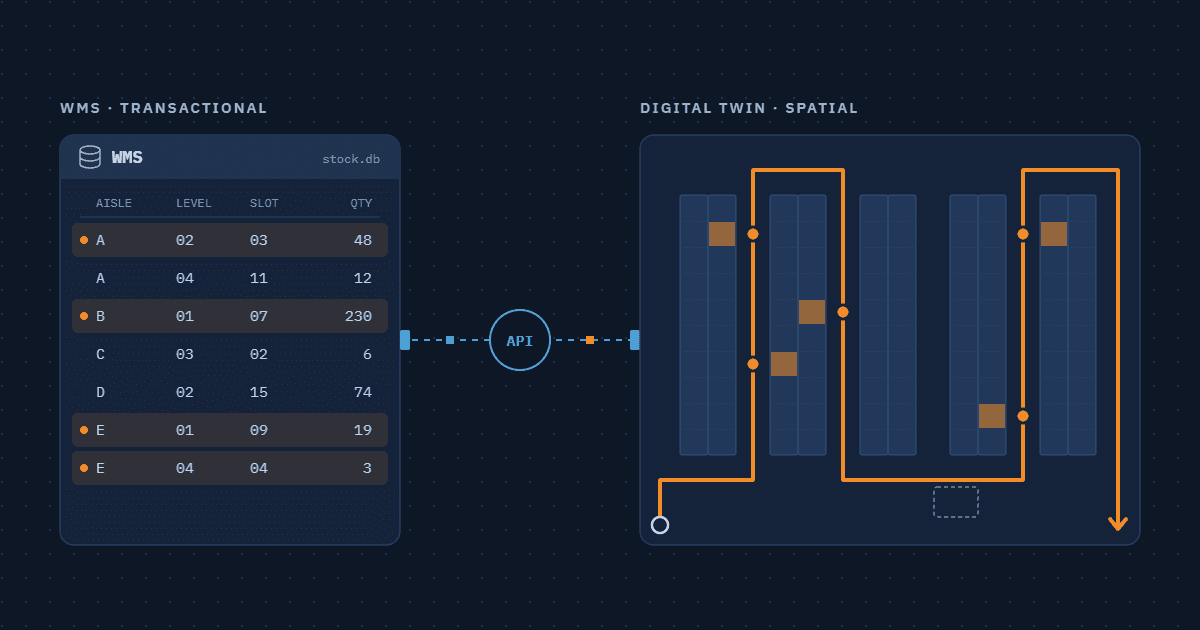
- Optimizing warehouse picking paths relies on accurate route calculation, but most WMS use a static location-to-location distance matrix, not a dynamic point-to-point calculation.
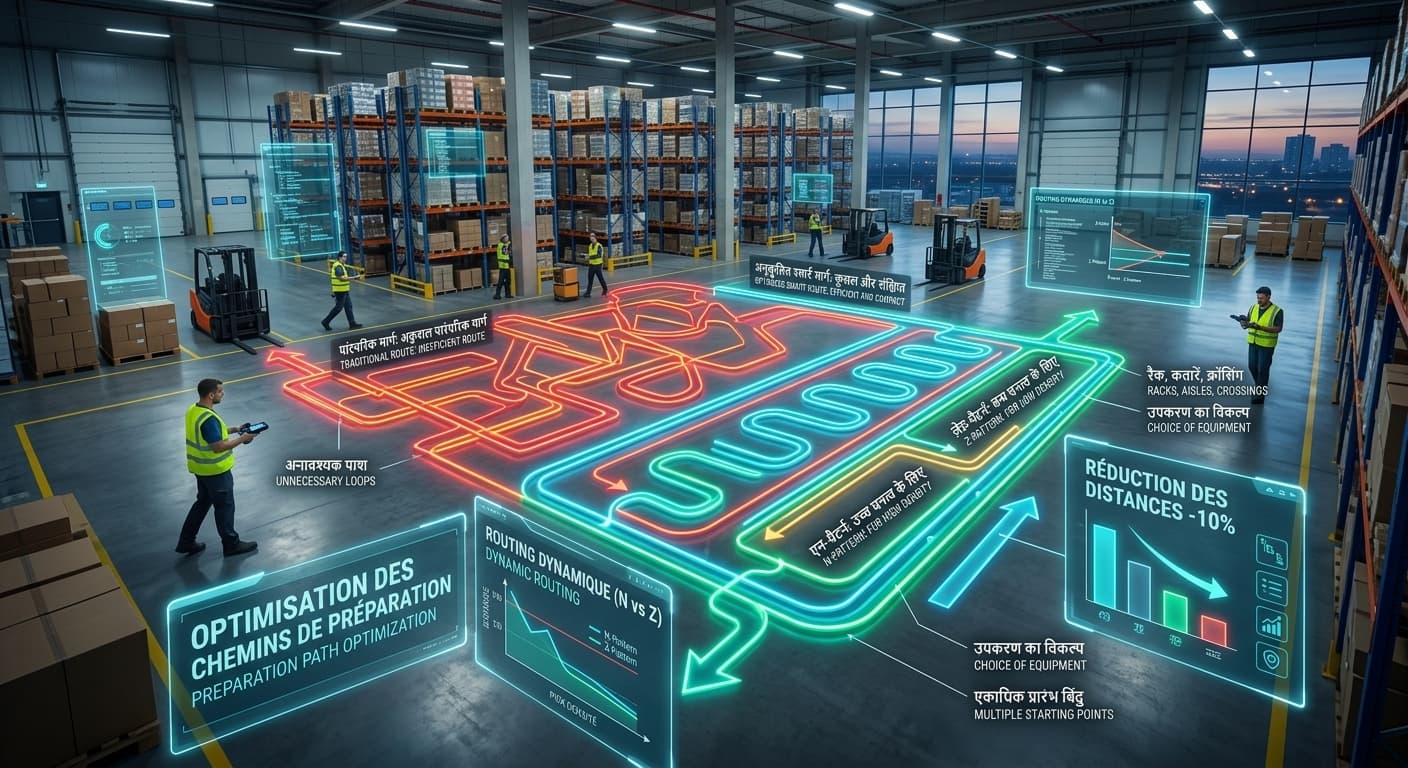
- Three aspects are systematically underused: transverse aisles as shortcuts, equipment selection, and multiple starting points.
- N-picking (serpentine) and Z-picking (partial return) do not yield the same results depending on pick density. A WMS that applies a fixed method does not adapt to each task.
- A dynamic calculation integrates all actual waypoints (racks, docks, crossings, equipment) and sequences each task according to the routing method defined up front (N or Z) by the warehouse manager.
- If warehouse traffic flow changes, the impact on the pick sequence is recalculated immediately, with no manual reconfiguration.
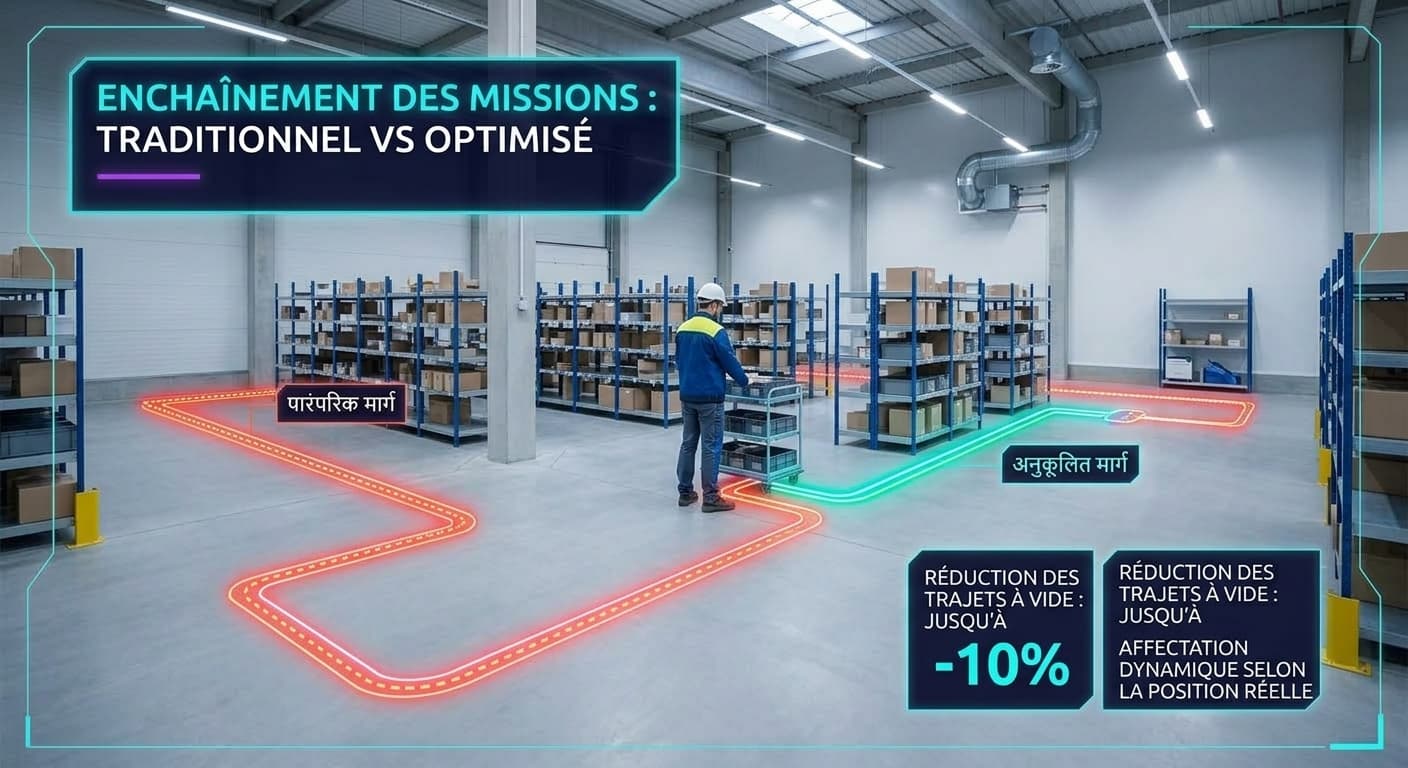
- Measured gain on picking paths: 5% to 20% of distance traveled, average gain 10%
can be combined with task grouping (20%) and slotting (25%).
What your WMS does: the location-to-location distance matrix
The WMS distance matrix calculates the distance between two storage locations—from one rack to another. It does not model the actual route a picker takes between two picks.
What the distance matrix covers:
- Distance between two rack references (A-01-01 -> B-03-05)
- Sequencing the pick list according to this distance order
- Assigning a fixed default starting point
What the distance matrix does not cover:
- Actual intermediate waypoints: crossings, departure docks, conveyors, staging areas
- Handling equipment and their specific traffic constraints
- Transverse aisles usable as shortcuts between zones
- References with multiple storage addresses (multi-location)
- Task dynamics: the actual distance depends on the exact composition of picks, not a generic rule
Direct consequence:
- The WMS approximates the route—it does not calculate it.
- The generated pick sequence is coherent on paper, suboptimal in the physical warehouse.
- Pickers deviate from the prescribed path because it does not match the reality on the ground.
Three underused aspects by standard WMS
Transverse aisles
WMS generally ignore transverse aisles as shortcuts between longitudinal zones.
- What happens: the picker is guided to the end of the aisle, turns around, goes up a parallel aisle—whereas a transverse aisle would have allowed a direct cut-through.
- Consequence: unnecessary detours on every task, invisible in the static distance matrix.
- What this means: in a warehouse with 10 aisles and 2 transverse aisles, several hundred meters of detour per shift are silently absorbed.
Equipment selection
In most warehouses, several fixed peripheral devices are available at different locations: label printers at aisle ends, wrapping machines in drop zones, stackers at zone entry. When multiple instances of the same equipment exist, the choice of which to use directly impacts the picking path.
Concrete examples:
- Two label printers available: one at the end of aisle A, one at the end of aisle D. Depending on the task composition, one or the other represents a detour of 80 to 150 meters.
- Two wrapping machines available: one in zone B, one in zone F. If the task ends near zone B, using the wrapper in zone F adds an unnecessary round trip.
- Single stacker at zone entry: if the task starts on the opposite side, the detour to reach the stacker can represent several hundred meters per shift.
What the WMS does:
- It assigns a default equipment—often the same for all tasks, regardless of their composition.
- It does not calculate which of the available devices minimizes the detour in the context of the current task.
Consequence:
- Systematic detours, invisible in the static distance matrix.
- The optimal equipment choice depends on the actual pick sequence—a variable the WMS does not process.
Multiple starting points
Some warehouses have several possible starting points for a task: dock A, consolidation area, intermediate drop station.
- The WMS chooses a default starting point—often the same for all tasks.
- It does not calculate which one actually minimizes the overall route based on the task composition.
- Result: tasks that start from the wrong side of the warehouse, with extra kilometers absorbed without being measured.
N-picking, Z-picking: when the method changes everything
Two picking routing methods dominate operational practice. They do not yield the same results depending on pick distribution.
N-picking (serpentine)
- The picker goes through the aisles end-to-end, in a continuous back-and-forth.
- They enter from one side, exit from the other, enter the next aisle.
- Simple to configure, easy for operators to understand.
- Limitation: if picks are concentrated at the start of the aisle, the picker walks the entire aisle for nothing.
Z-picking (partial return)
- The picker enters an aisle, picks, and exits from the same side if the remaining picks are upstream.
- Reduces distances in aisles with low pick density.
- Limitation: in a high-density aisle, the partial return generates more distance than the serpentine.
Comparison table N vs Z
Criterion | N-picking | Z-picking |
|---|---|---|
Principle | Serpentine end-to-end | Partial return via the same side |
Optimal conditions | Picks spread along the entire aisle length | Picks concentrated at the start or end of the aisle |
Advantage | Simplicity, route predictability | Distance reduction in low-density aisles |
Limitation | Aisles crossed empty if picks are rare | Less effective in high-density aisles |
WMS configuration | Easy—fixed rule | Requires calculation per aisle and per task |
The central issue: a WMS that applies a fixed method (N or Z) does not adapt to the reality of each task. A task with 3 picks across 10 aisles does not call for the same method as a task with 30 picks across 4 aisles. Optimizing warehouse picking paths requires adapting to each task.
Find & Order: from static distance matrix to dynamic path calculation
Find & Order goes beyond the static distance matrix in four dimensions.
Dynamic point-to-point calculation
- Modeling all actual waypoints: racks, equipment, docks, crossings, staging areas.
- Not just storage locations—all nodes of the physical route.
- The calculated distance matches the route the picker actually takes.
Integration of traffic constraints
- Transverse aisles integrated as effective shortcuts in the movement graph.
- Warehouse traffic flow taken into account for each segment of the route.
- Restricted access areas (cold zones, secure areas) included in the calculation.
Automatic starting point selection
- For each task, the best starting point is calculated based on the actual pick composition.
- No fixed default starting point—the calculation adapts to each task.
Picking method: an input constraint, not an automatic choice
- Find & Order does not automatically decide the picking method (N or Z): it is a constraint defined up front by the warehouse manager.
- If this constraint changes—switching from N-picking to Z-picking, changing traffic flow—just update the parameter.
- The algorithm immediately recalculates all pick sequences, with no further reconfiguration.
- The 3D digital twin ensures the calculation reflects the real warehouse, not a 2D approximation.
Operational constraints: how algorithms absorb them
WMS compensate for their lack of precision with rigid rules: fixed number of zones, hard-coded priorities, hardwired traffic constraints. Every warehouse reorganization triggers a reconfiguration project.
Find & Order does the opposite.
Real-time calculation entrusts algorithms with enforcing basic rules while minimizing distances. Result: fewer rules to maintain, less reconfiguration.
Concrete examples:
- Reduction in the number of required zones- when dynamic calculation already optimizes compactness, rigid zone segmentation becomes less useful. Fewer zones = fewer rules to maintain.
- Priorities recalculated for each task- based on actual pick density, not fixed configuration. A priority zone at 9am may not be at 2pm if task composition has changed.
- Absorbing layout changes- if traffic flow changes, the WMS distance matrix requires manual intervention. Find & Order automatically recalculates all pick sequences.
- Multi-addresses natively managed- for references with multiple storage locations, the best location is selected on the fly based on the picker's current position in their task.
Comparison table: WMS only vs Find & Order
Dimension | WMS only | Find & Order |
|---|---|---|
Type of distance matrix | Static—location to location | Dynamic—point to point (racks, docks, equipment, crossings) |
Transverse aisles | Ignored | Integrated as shortcuts in the movement graph |
Starting point selection | Fixed by default | Calculated for each task based on pick composition |
Change of picking method (N/Z) | Full manual reconfiguration | Parameter update -> automatic recalculation |
Impact of a change in traffic flow | Manual reconfiguration required | Automatic recalculation of pick sequence |
Constraint management | Rigid hard-coded rules | Adaptive algorithms—fewer rules, more flexibility |
Multi-address references | Fixed default location | Best location dynamically selected |
KPIs to measure the impact on picking paths
Six KPIs to drive picking path optimization in the warehouse.
- Total distance traveled per task
- Definition: cumulative distance (in meters) or travel time per complete task.
- What an improvement means: direct reduction in non-productive time—every meter saved translates into additional picks per hour.
- Number of aisles crossed per task
- Definition: number of distinct aisles used to complete a task.
- What an improvement means: a compact task stays within a reduced perimeter—indicator of picking routing and task grouping quality.
- Rate of aisles crossed without picking
- Definition: share of aisles crossed with no picks at all ("empty" aisles).
- What an improvement means: transverse aisles and Z-routing reduce this rate—every aisle crossed should contribute to the task.
- Inter-pick distance
- Definition: average distance between two consecutive picks within the same task.
- What an improvement means: direct indicator of pick sequence compactness—its reduction validates that routing adapts to the actual pick distribution.
- Average task time
- Definition: total time from start to end of a task, including travel, picking, and handling.
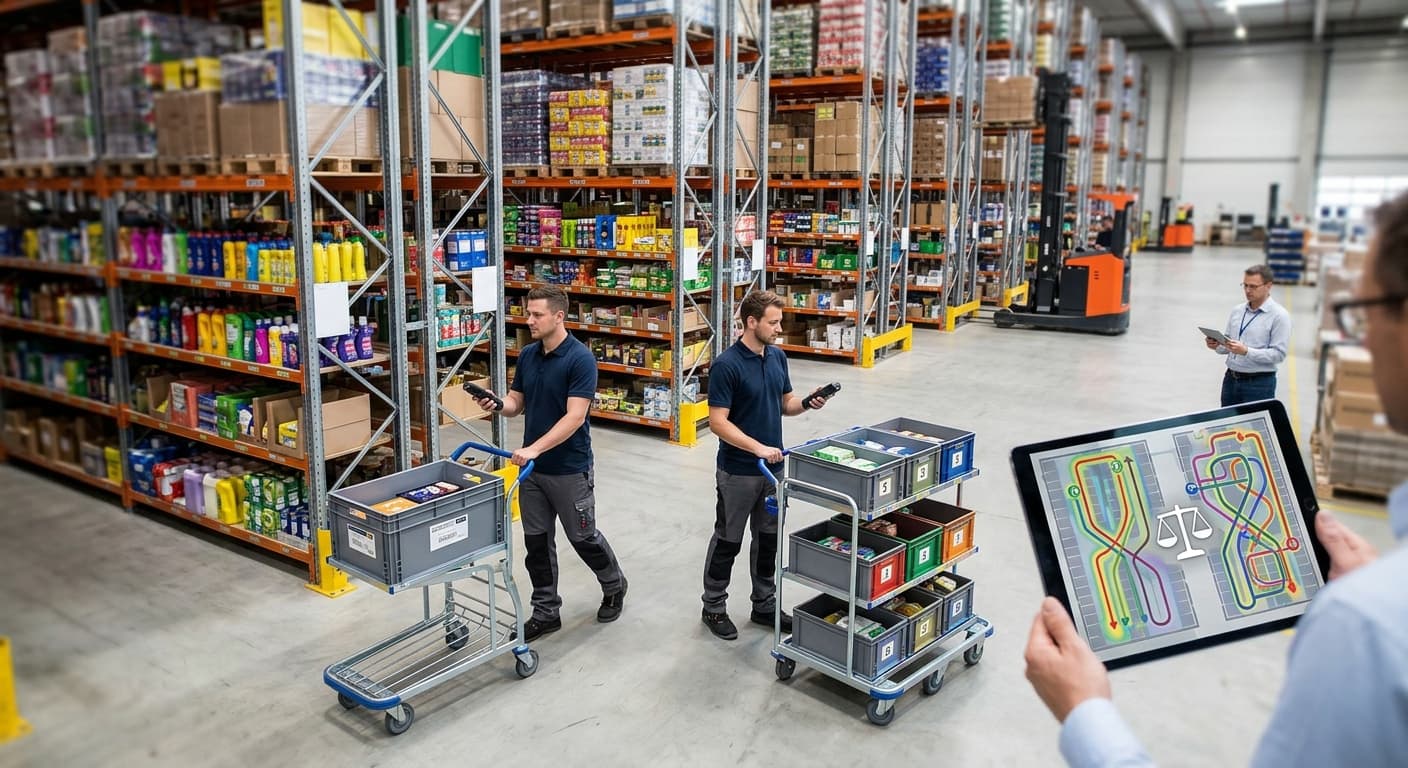
- What an improvement means: actual workload indicator – more accurate than the number of lines for balancing tasks between pickers (SMB/MTM method).
- Gap between theoretical path and actual path
- Definition: measures the picker’s adherence to the route prescribed by the system.
- What an improvement means: a high gap reveals that the prescribed route is not workable in the real warehouse – a sign that the WMS distance calculator does not reflect the actual layout.
Tangible results
Gains on picking routes
- Reduction in distance traveled: from 5% to 20% depending on movement constraints
- Average measured gain: 10%
Cumulative leverage effect
These gains add up with other optimization levers:
- Creation of compact tasks: average gain 20% (up to 25% in distances)
- Slotting: average gain 25% (up to 30% on picking distances)
- Optimized picking routes: average gain 10% (up to 20% depending on constraints)
Each lever applies to a flow already improved by the previous ones – gains are cumulative, not alternative.
Estimate your potential gains with the Find & Order gains calculator.
FAQ
What is the difference between N picking and Z picking?
The N picking (or serpentine) guides the picker from end to end in each aisle, in a continuous back-and-forth. Simple to apply, it generates long distances when picks are concentrated at the start of the aisle—the picker travels the entire aisle for just a few picks.
The Z picking (or partial return) allows the picker to exit from the same side if the remaining picks are upstream. It reduces distances in aisles with low pick density, but becomes less efficient than serpentine in very dense aisles. The optimal method depends on the exact composition of each task and the warehouse's traffic constraints. In Find & Order, the method (N or Z) is set upfront by the warehouse manager—if it changes, updating a single parameter is enough for the algorithm to recalculate all sequences.
Do I need to reconfigure Find & Order if I reorganize the warehouse?
No. If traffic directions change, if cross-aisles are added, or if zones are reorganized, Find & Order automatically recalculates all picking sequences. The 3D digital twin is updated once—the algorithms adapt without manual intervention on routing rules. This is the opposite of a WMS, which requires explicit reconfiguration with every layout change.
How can I tell if my current picking paths are optimal?
Three signals reveal suboptimal routing:
- High rate of empty aisles : pickers regularly cross aisles without picking—routing does not take advantage of cross-aisles or partial returns.
- Gap between prescribed path and actual path : if pickers consistently deviate from the path suggested by the WMS, it means the distance calculator does not reflect the warehouse's physical reality.
- High inter-pick distance : an average distance between two consecutive picks higher than what the warehouse density should allow indicates routing poorly adapted to the location distribution.
These three indicators can be measured without a transformation project—they are enough to establish an initial diagnosis.
Visite our website page dedicated to our optimizations, and specifically to pick path optimization.