



Warehouse task planning: why your WMS generates too many empty trips between tasks
 HugoDeveloper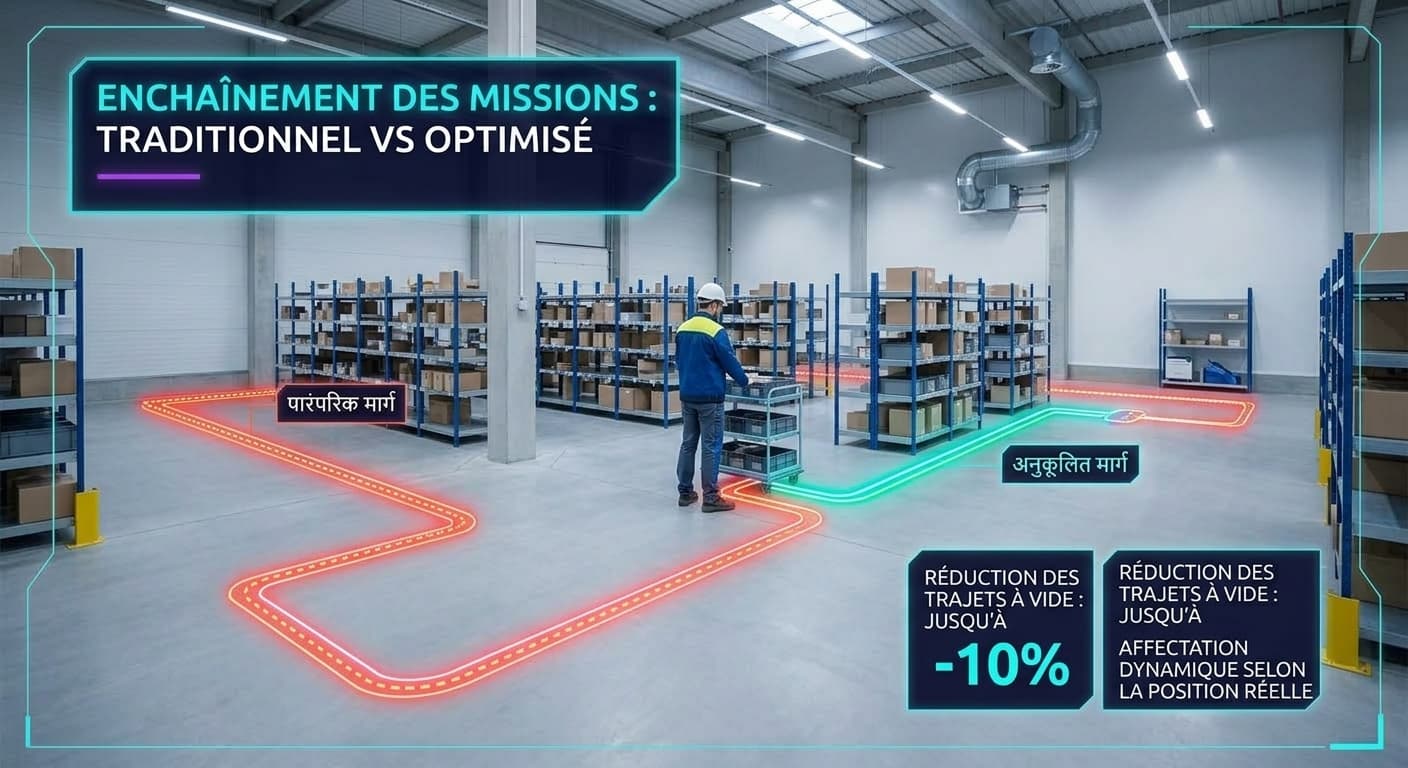
What the WMS does not do: optimize the sequencing of tasks
A WMS manages the creation and distribution of picking tasks. What it does not do: optimize the order in which these tasks are assigned to each picker.
The structural problem
- The WMS does not know the exact position of the picker at the end of each task.
- It does not calculate the actual distance between the drop-off point of a completed task and the pick-up point of the next task.
- It assigns the next task according to priority or availability rules—not based on geographic proximity.
What this causes
- A picker finishes a task in zone B, on the east side of the warehouse.
- The WMS assigns them the next task, which starts in zone D, on the west side.
- The picker crosses the warehouse empty—no picking, no added value.
What the WMS cannot calculate
- The actual distance between any two points in the warehouse in real time.
- The impact of this assignment choice on the total empty distance for the shift.
- The best task to assign among those available, based on the picker's current position. Result: empty trips between tasks accumulate on each shift, invisible in standard WMS KPIs.
How Find & Order optimizes task sequencing
Minimizing empty trips between tasks
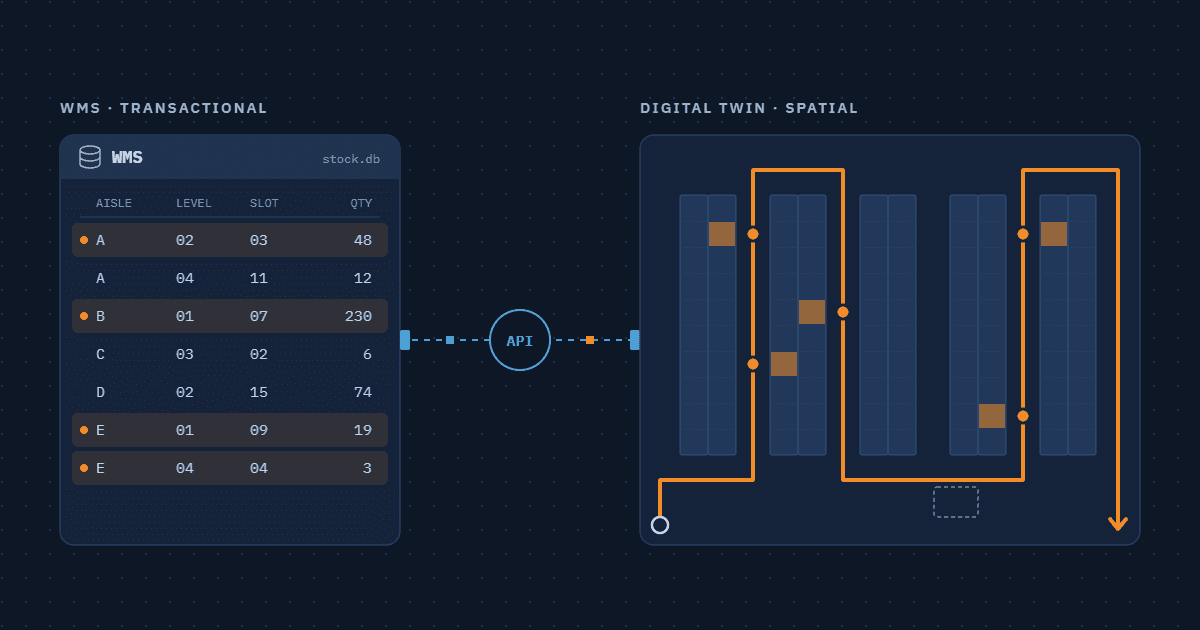
Find & Order uses the 3D digital twin to calculate in real time the exact distances between any two points in the warehouse.
The assignment principle
- At the end of each task, the picker's position (drop-off point) is known precisely.
- The algorithm calculates the distance between this point and the pick-up point of each available task.
- The task whose starting point is closest to the picker's current position is assigned to them.
- The calculation is repeated dynamically after each completed task.
What this changes
- Fewer empty warehouse crossings between two tasks.
- Each sequence is individually optimized, in real time.
- The effect is cumulative over the course of a shift: each well-sequenced task reduces the total empty distance traveled
Integrating picker profiles and organizational rules
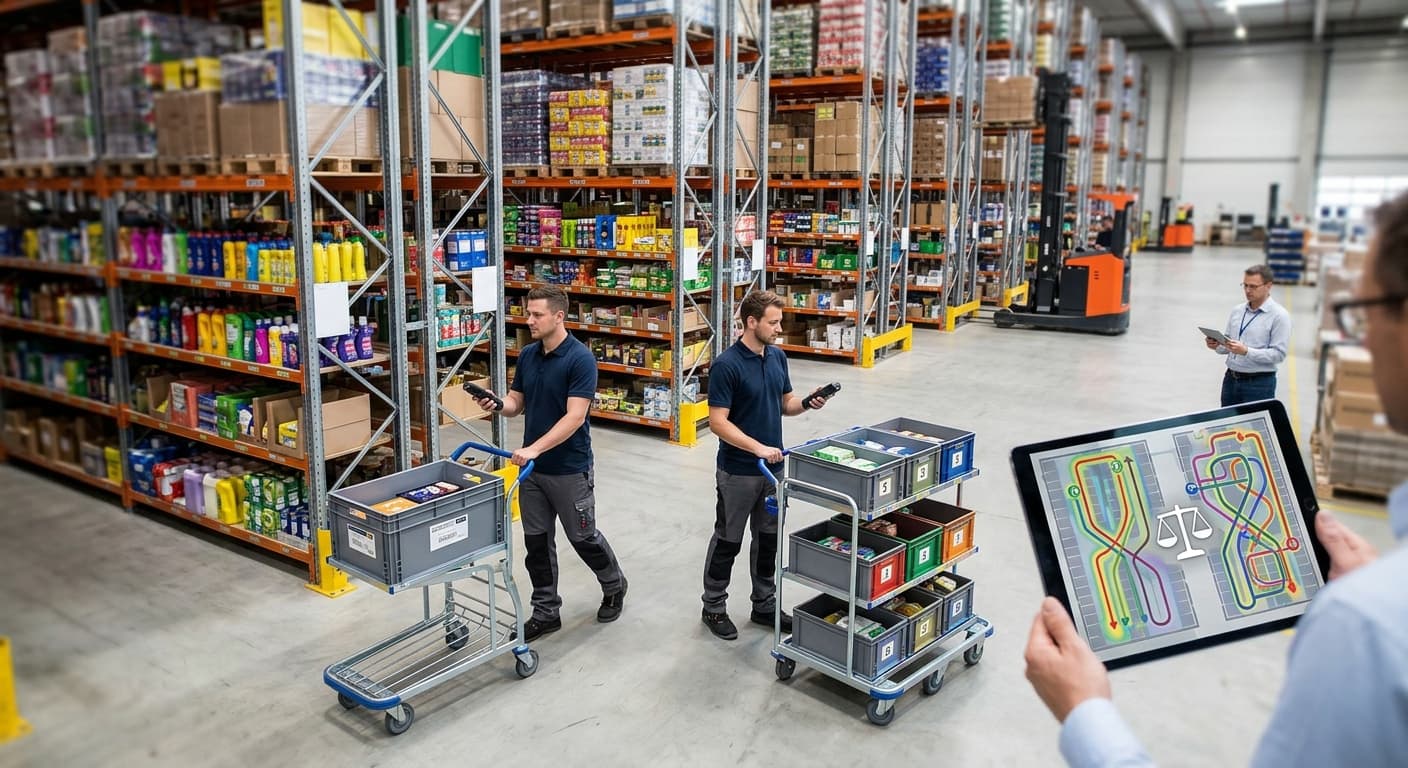
Optimizing task sequencing is not limited to geographic proximity. Organizational constraints are integrated as input parameters defined by the warehouse manager.
Examples of profiles and rules that can be integrated
- Single-client vs multi-client tasks : some pickers only handle single-client tasks (regulatory, contractual, or organizational constraint); others can handle multi-client tasks.
- Certifications and skills : a picker certified to work in cold or secure zones is assigned the corresponding tasks as a priority.
- Specific equipment : a picker using a forklift does not receive the same tasks as a picker on foot.
- Priority rules : urgent tasks or those with imminent shipping constraints can be prioritized in the assignment algorithm.
What this ensures
- Organizational rules are respected with every assignment—they are not bypassed by optimization.
- The algorithm looks for the closest task among those compatible with the picker's profile.
- The warehouse manager retains control over the rules; the algorithm ensures their systematic application.
Prerequisite: multiple starting points
This optimization lever relies on a structural condition of the warehouse.
Necessary condition
- The warehouse must have multiple possible starting points for tasks (several docks, several drop-off zones, several starting stations).
- If the warehouse has only one fixed starting point, all pickers start from the same place after each task—there is no lever for sequencing optimization.
What this implies
- In a warehouse with multiple drop-off zones, the end point of a task varies depending on the composition of the picks—and sequencing optimization delivers real gains.
- The more possible starting points there are, the greater the potential gain on empty trips.
- This parameter is checked upstream during the warehouse diagnosis—it determines the applicability of the lever.
WMS alone vs Find & Order: comparison table
Dimension | WMS alone | WMS + Find & Order |
|---|---|---|
Distance calculation between tasks | Absent—no real-time point-to-point calculation | Dynamic 3D distance calculator—exact distance between drop-off and pick-up points |
Assignment criterion for the next task | Priority or availability—not proximity | Geographic proximity calculated in real time |
Picker profiles | Static rules configured | Dynamic constraints integrated with each assignment |
Recalculation during the shift | Absent—assignment fixed at creation | Recalculation after each completed task |
Applicability condition | Not checked | Multiple starting points required—checked upstream |
Empty trips between tasks | Not optimized | reduced by up to 10% |
KPIs and results
Gain from this lever
- Reduction of empty distances between tasks: up to 10%
- Gain applies only if the warehouse has multiple possible starting points.
Indicators to track
- Empty distance per shift : total distance traveled without active picking—direct indicator of task sequencing efficiency.
- Empty distance per task : average distance between the drop-off point of one task and the pick-up point of the next.
- Empty trip rate : share of total trips made without picking—cross-referenced with the number of tasks per shift.
- Inter-task time : average time between the end of one task and the first pick of the next—indicator of sequencing quality.
Cumulative effect with other levers
This lever is the 4th in the optimization stack. The gains are complementary:
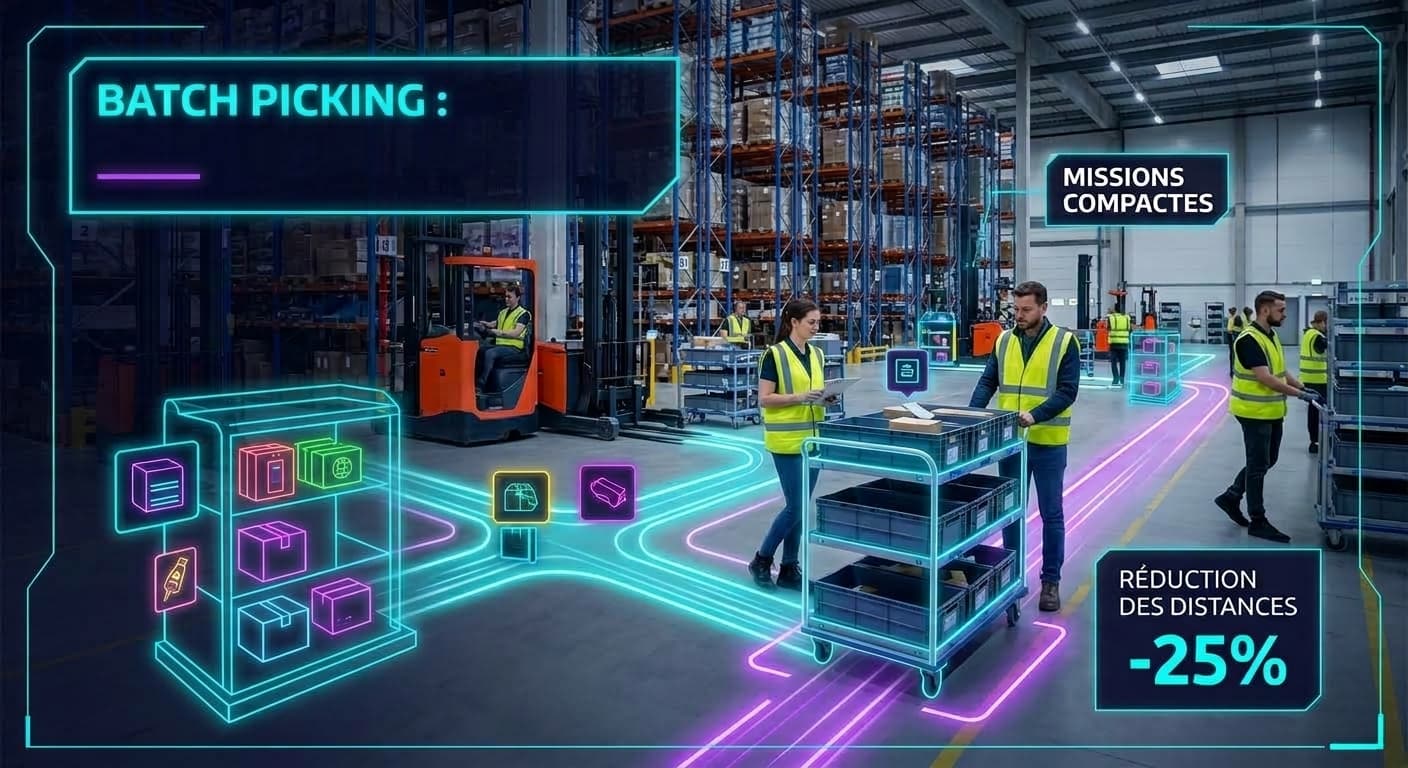
- Building compact tasks: average gain of 20% (up to 25% on distances)
- Optimized picking paths: average gain of 10% (up to 20% depending on constraints)
- Slotting: average gain of 25% (up to 30% on picking distances)
- Task sequencing: up to 10% on empty distances
Each lever applies to a flow already improved by the previous ones—the gains are cumulative, not alternative.
FAQ
What is an empty trip between tasks?
An empty trip between tasks is the route a picker takes between the end of one task (drop-off point) and the start of the next task (pick-up point). This trip does not generate any picks—it is entirely non-productive. In a warehouse where tasks are assigned without sequencing optimization, these trips can represent a significant share of the total travel time in a shift.
Why can't the WMS optimize task sequencing?
The WMS is not designed to calculate in real time the exact distances between any two points in the warehouse. Its distance calculator is static—it calculates distances between storage locations, not between drop-off points that vary with each task's composition. Without this dynamic point-to-point calculation, it cannot determine which available task is closest to the picker's current position.
Is this lever compatible with strict organizational rules?
Yes. Organizational rules—picker profiles, certifications, single-client or multi-client tasks, shipping priorities—are integrated as input constraints in the assignment algorithm. Proximity optimization applies only among tasks compatible with the picker's profile. The rules defined by the warehouse manager are not bypassed—they are guaranteed with every assignment.
Does this lever apply to all warehouses?
No. Optimizing task sequencing requires that the warehouse has multiple possible starting points. If all tasks start from a single fixed point, pickers always start from the same place—optimized sequencing has no lever to act on. This prerequisite is checked during the initial diagnosis, before any implementation.