



Logistics picking: reminders and perspectives on a key warehouse activity
 ArthurCoFounder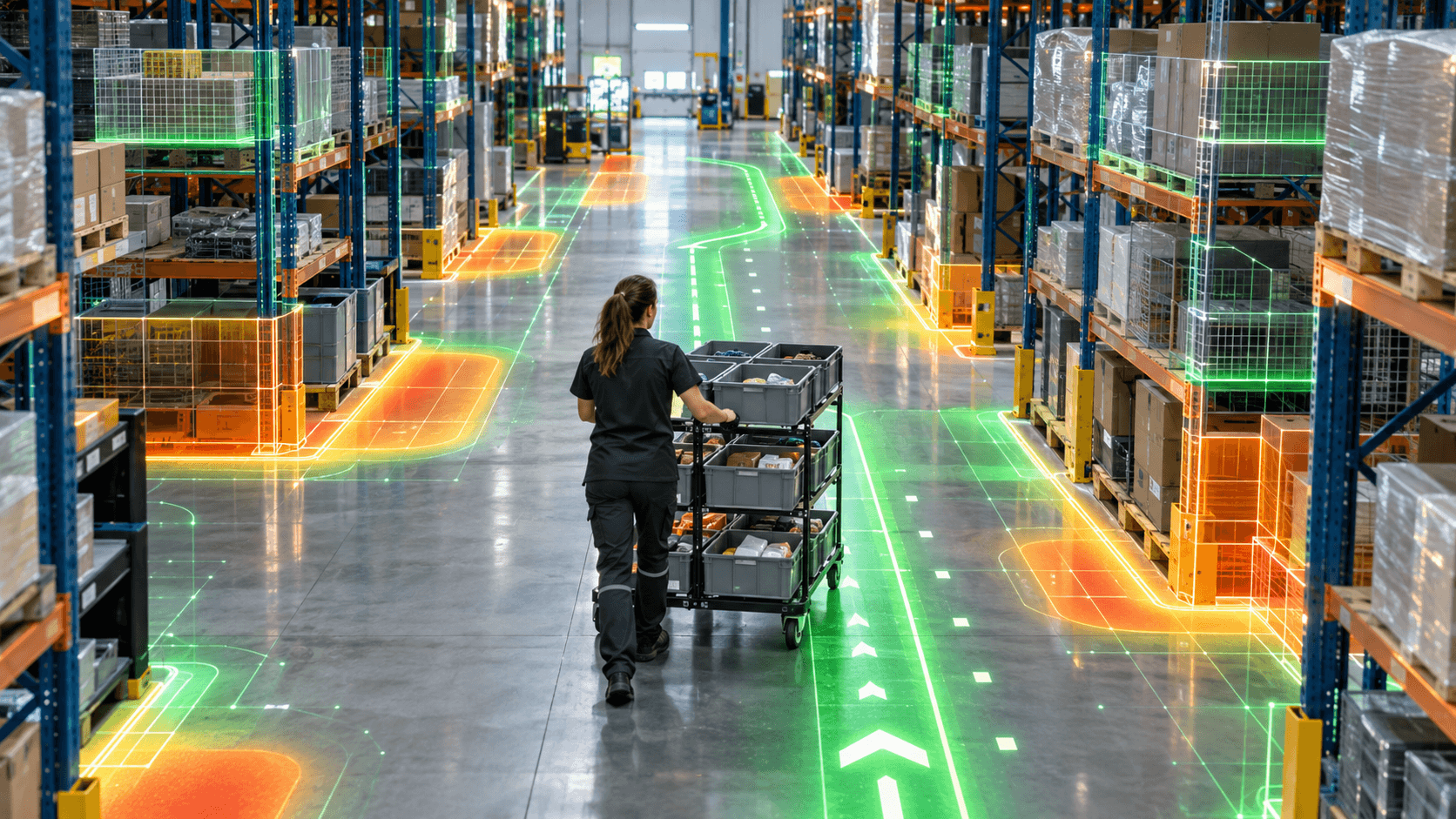
In the world of supply chain and retail logistics, performance is measured down to the square meter and the second. With the rise of omnichannel, e-commerce, and ever-stricter delivery requirements, warehouses are under unprecedented operational pressure. At the heart of this complex system lies a pivotal operation, both a value generator and a major source of costs: logistics picking.
Often representing more than 55% of a warehouse's operating costs, order picking is the primary productivity lever for a site. Yet many supply chain managers today find themselves facing a technological wall: their legacy Warehouse Management System (WMS), while robust for inventory management, struggles to provide the algorithmic agility needed to optimize routes in real time.
This reference guide aims to define the fundamentals of picking, compare the main picking methods, and show how an intelligent software layer can turn your existing WMS into a high-performance engine.
What is logistics picking?
Picking: definition and role in the supply chain
To understand the performance challenges, it is important to provide a clear definition of picking. The term picking (translated in French as "cueillette", "prélèvement" or more commonly "préparation de commande") refers to the action of extracting products from their initial storage location to group them together for shipping a customer order.
Logistics picking is the first physical step in the packing chain. Its role is critical: delivery error rates depend on its accuracy, and meeting cut-off times depends on its speed. In retail logistics, where orders contain a large number of SKUs but low volumes per line, picking becomes the most fragmented and time-consuming operation in the warehouse.
The 4 key steps of a picking task
A standard picking operation is systematically broken down into four distinct phases, each representing an opportunity for optimization:
- Travel (or route) : The picker moves from their starting area to the aisle and storage location of the product. This is the most expensive phase, accounting for up to 50% of the total time of a task.
- Search and identification : Once at the storage address, the operator must visually locate or use a radio frequency (RF) terminal to find the correct item.
- Physical picking : The action of grabbing the required quantity of product and placing it in the picking container (bin, cart, pallet).
- Validation and drop-off : Scanning the barcode (location and product) to update inventory in real time, followed by transporting the parcels to the packing or consolidation area.
Picking methods: comparative analysis
There is no single picking method, but a multitude of organizational strategies. The choice depends on the type of orders (B2B, B2C), the number of SKUs, and the physical structure of the warehouse.
- Unit Picking (Pick-to-Light, Order Picking)
The simplest method: a picker handles one order at a time, moving through the warehouse to pick all the items for that order.
- Advantages: Virtually zero error risk, no sorting or consolidation step required after picking.
- Disadvantages: Very low productivity. If two consecutive orders require the same product at the other end of the warehouse, the picker will make the same trip twice.
- Batch Picking
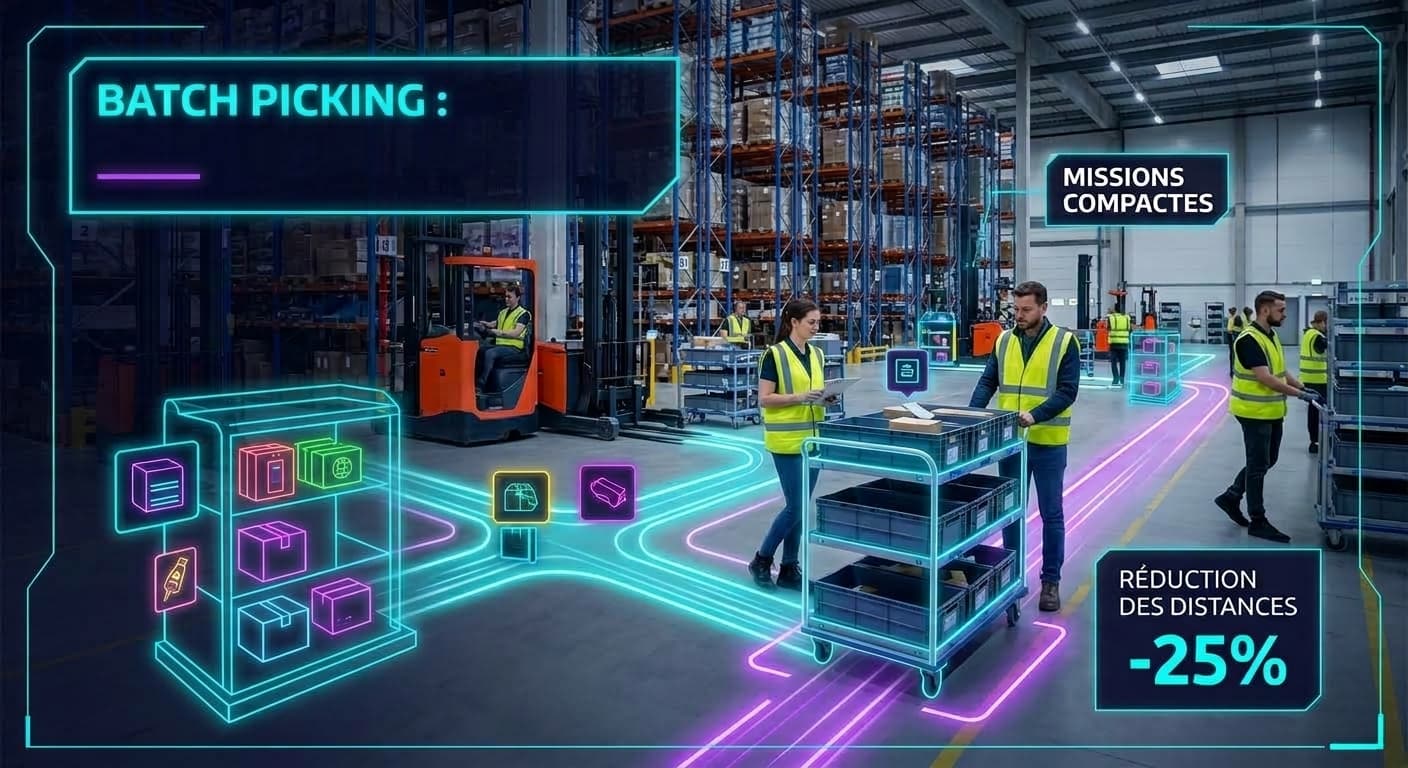
The picker collects items for several orders simultaneously in a single trip. The picking cart is often divided into several bins, each associated with an order.
- Advantages: Drastically reduces distances traveled, as trips are shared for multiple customers.
- Disadvantages: Risk of mixing up items between bins. Requires a rigorous guidance system (such as Put-to-Light).
- Zone Picking
The warehouse is divided into several distinct geographic zones. One or more pickers are assigned exclusively to each zone. An order moves from zone to zone (Pick-and-Pass method) or items picked in parallel in each zone are later consolidated in a consolidation area.
- Advantages: Operators become experts in their area, aisle congestion is greatly reduced.
- Disadvantages: Risk of bottlenecks if one zone is overloaded compared to another (load balancing issue).
- Wave Picking
Orders are grouped into "waves" based on common logistics criteria: carrier, product type (chilled, dry), delivery priority, or customer profile. Pickers go out in batch or by zone to complete the wave within a set time frame.
- Advantages: Perfect optimization of outbound flows and truck departure times.
- Disadvantages: Lack of flexibility. Once the wave is launched, it is very difficult to insert a last-minute urgent order.
- Waveless Picking (Continuous Dynamic Picking)
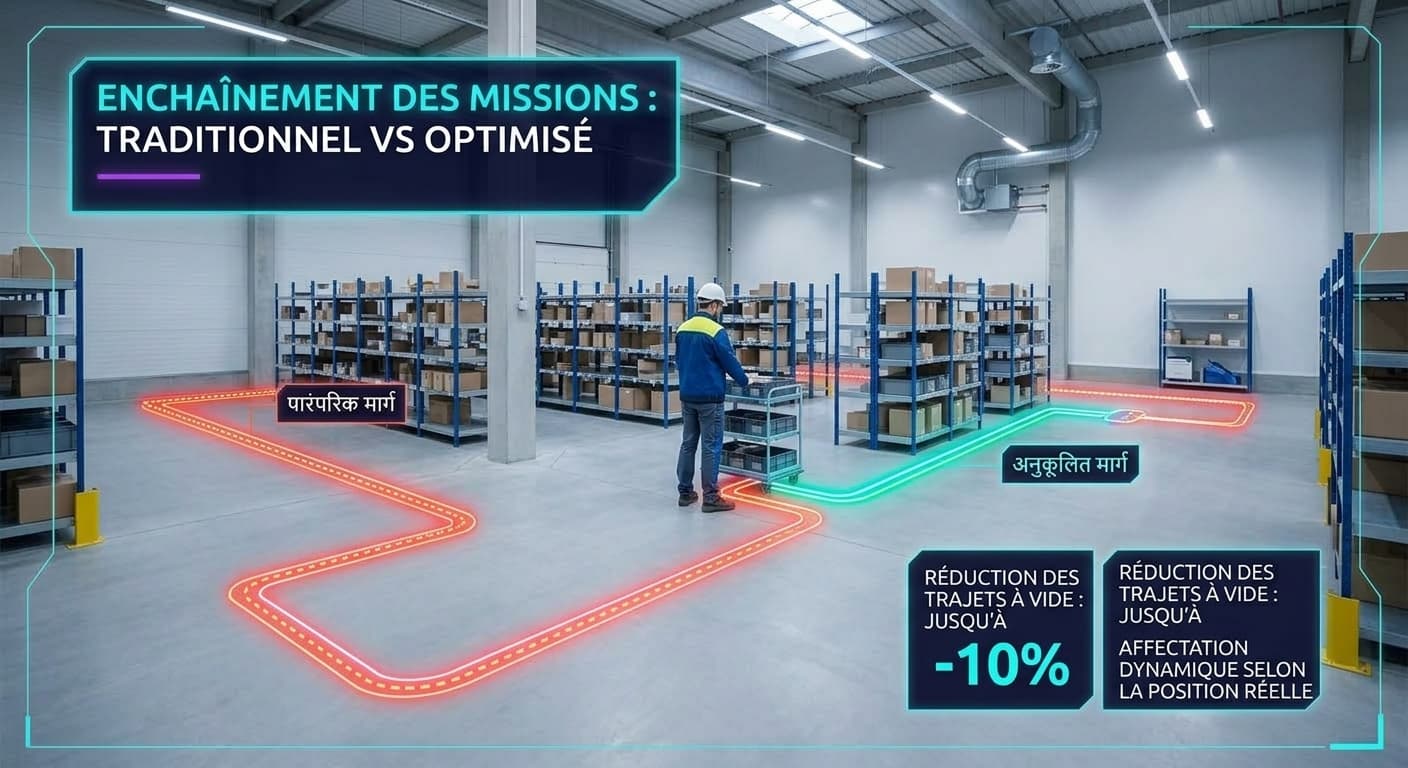
The latest evolution born from e-commerce, waveless picking eliminates the rigid concept of waves. Orders are re-evaluated in real time as soon as they are received. The system dynamically reassigns picking tasks to available pickers based on their geolocated position in the warehouse.
- Advantages: Maximum agility, instant integration of urgent orders.
- Disadvantages: Requires very high algorithmic computing power, often beyond the reach of traditional WMS.
Method | Ideal typology | Impact on distances | IT complexity | Error risk |
|---|---|---|---|---|
Unit | B2B, Large volumes / pallets | High (Repeated trips) | Low | Very low |
Batch picking | E-commerce B2C (Small parcels) | Low (Shared) | Medium | Moderate (Mix-ups) |
Zone picking | Large retail, High SKU count | Low (Stationary operator) | High | Medium |
Wave picking | Omnichannel with strict cut-offs | Medium | High | Low |
Waveless | Pure e-commerce with high volatility | Very low (Real-time optimization) | Very high | Low (if guided) |
Manual picking vs automated picking: which use cases?
The debate between conventional (manual) warehouses and automated (Goods-to-Man) warehouses has intensified with the emergence of advanced technologies.
PICKING STRATEGIES IN THE WAREHOUSE | |
|---|---|
MAN-TO-GOODS (Manual Model) | GOODS-TO-MAN (Automated Model) |
|
|
|
|
|
|
|
|
The Man-to-Goods model
In the classic setup, the picker moves on foot or with a forklift to the product. While this model is often criticized for its physical demands, it retains an unbeatable advantage: flexibility. Modifying the layout of a manual warehouse takes a few days; installing new shelving is simple, and the initial investment (CAPEX) remains controlled. The main challenge of Man-to-Goods lies solely in the efficiency of picking routes. If the route calculation algorithms are faulty, the site immediately loses profitability.
The Goods-to-Man model
Here, the operator remains stationary at their picking station. Automated systems — such as stacker cranes, shuttles, AutoStore systems, or fleets of autonomous mobile robots (AMR) — retrieve storage bins and bring them directly to the picker. This model should be considered when maximum storage density is required (land pressure), order volumes are huge and standardized, and the company has a high long-term investment capacity.
However, heavy automation locks the warehouse in place. If your parcel types change drastically, or if a hardware failure occurs in the central system, the entire logistics chain is paralyzed. That's why most retail players favor a hybrid model: optimizing existing manual and semi-mechanized operations before considering full automation.
How to optimize picking without changing your WMS?
When a logistics site loses productivity, the first reaction is often to blame the WMS and consider replacing it. This is a major strategic mistake. Changing a WMS takes 12 to 18 months, costs hundreds of thousands of euros, and carries a huge risk of operational downtime. The modern alternative? The middleware approach. This involves adding an intelligent, specialized software layer on top of your existing WMS to boost its optimization capabilities without touching its secure foundations. This is precisely the DNA of the Find & Order solution.
- Slotting or storage location optimization
Slotting (or stock zoning) involves assigning the best possible address to each product based on its turnover rate. Based on the Pareto principle (the famous 20% of "A" products that generate 80% of picks), intelligent slotting automatically repositions high-turnover SKUs as close as possible to the main aisle and at picking height. By combining predictive sales analysis with a precise warehouse map, a middleware layer orchestrates daily micro-reorganizations.
- Drastic reduction of picking distances (-50%)
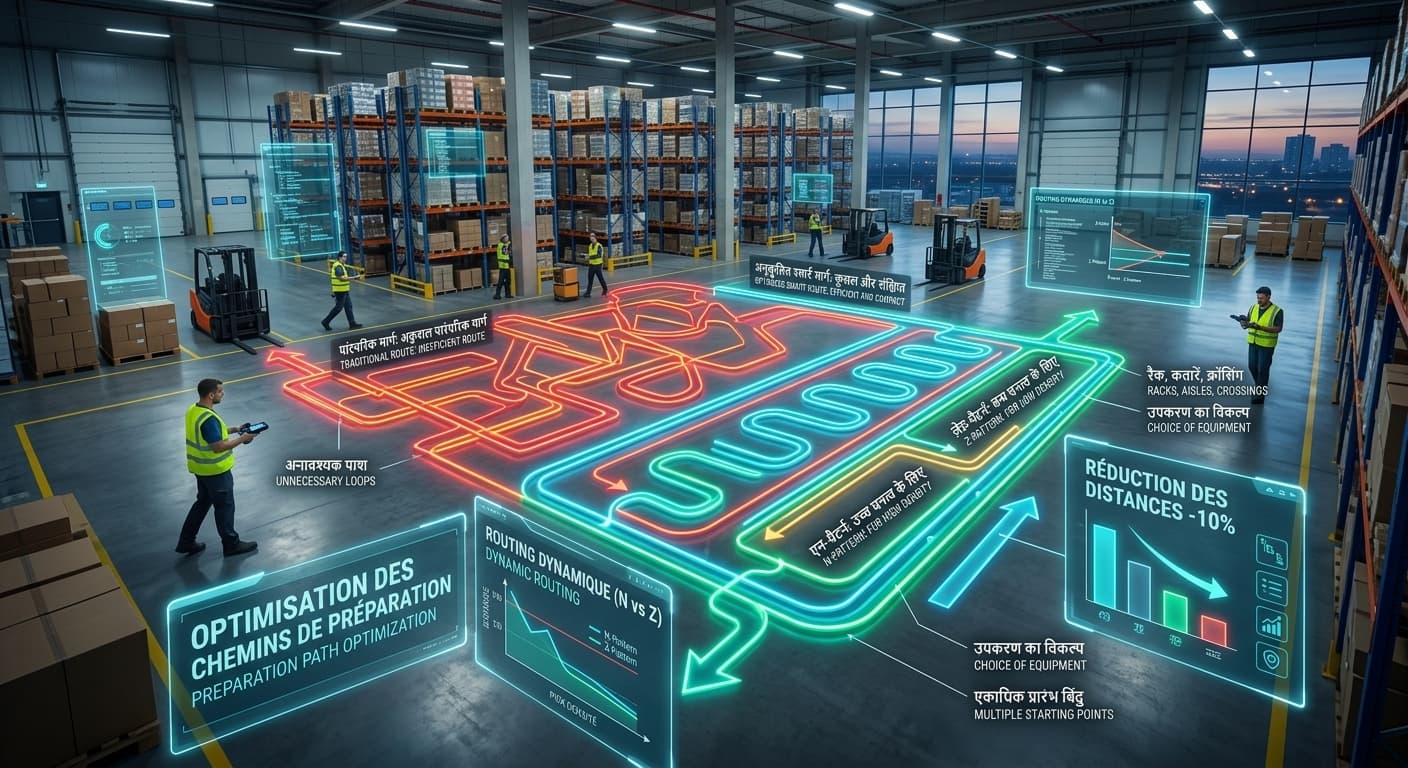
In a traditional warehouse, the WMS generates picking lists based on the numerical order of addresses (e.g., Aisle 01, Aisle 02, Aisle 03). However, this sequential order almost never matches the physically shortest route. The picker ends up making constant U-turns or unnecessary back-and-forth trips in the same aisle.
By integrating a digital twin of the warehouse, the advanced Find & Order algorithm calculates the optimal spatial route in three dimensions, taking into account real obstacles, aisle traffic flow, and cart size. Applying these geometric calculation models can reduce picking distances by up to 50% compared to native routes from classic WMS.
- Compacting picking tasks
The other major lever for software performance is intelligent scheduling. Instead of distributing orders as they come in or in static waves, the middleware continuously analyzes the backlog to design compact tasks. The tool groups together in the same batch orders whose picking points are geographically very close within the warehouse. This densification of picking maximizes the number of lines picked per meter traveled.
KPIs and performance monitoring for logistics picking
To effectively manage an order picking area, the manager’s eye alone is not enough; you need to rely on precise key performance indicators (KPIs), consolidated in real time through a data-driven approach.
Gross productivity and quality indicators
- Pick rate (Lines Per Hour - LPH): The number of item lines picked by an operator in one hour.
- Cost per picking line : Calculated by dividing the total labor cost of picking by the number of lines processed.
- Picking accuracy rate (Picking Accuracy Rate): The percentage of orders prepared without any reference or quantity errors.
Accuracy rate = (Correct orders ÷ Total orders prepared) × 100
An excellent rate is above 99.8%. Below this, return logistics costs increase significantly.
The contribution of the Digital Twin and the SMB (Standard Basic Handling)
Thanks to data analysis from a connected middleware, site managers no longer rely solely on activity reports after the fact. Integrating a Digital Twin makes it possible to model the warehouse in real time and in three dimensions, providing total visibility in the form of heatmaps to instantly identify congestion zones, flow disruptions, and slotting anomalies.
However, the real technological breakthrough occurs when this Digital Twin is coupled with the SMB (Standard Basic Handling). The SMB involves breaking down each micro-movement of the picker (walking, grabbing a parcel at eye level, scanning a label, placing it on a cart, etc.) into universal and predictable time standards. By combining these two dimensions, optimization reaches a new level:
- An ultra-precise Space-Time equation : The Digital Twin knows the exact distance down to the centimeter (spatial constraints), while the SMB associates it with the theoretical, irreducible calculation time dedicated to the action. The scheduling algorithm no longer just guesses the best route: it mathematically calculates the fastest and least strenuous mission.
- Predictive schedules and cut-offs : By knowing precisely the time required for each picking line based on the physical configuration of the aisle, the system can predict the exact end time of a wave or mission. Teams can thus dynamically adjust resource allocation to strictly meet carrier departure times.
- Scientific slotting arbitration : The system detects logistical anomalies not by volume, but by the second lost. If an item requires an abnormally high picking time according to the SMB, the Digital Twin immediately simulates a new ideal slotting location to validate the time and safety gain before physically moving the product.
This alliance between spatial geometry and task timing transforms picking continuously: logistics management shifts from a reactive, intuition-based model to scientific, predictive control, maximizing the efficiency of every second spent in the field.